No. 13 on the Sydney #TimeOutDoList: Explore experimental art and theatre at Carriageworks
I ventured over to Eveleigh on Tuesday night for my first #top50inSydney outing. The destination was Carriageworks, which is an art and performance space as well as home to a Saturday farmer’s market (a different excursion on the #TimeOutDoList). The List describes Carriageworks as a place to experience “experimental” theater and art. We are currently in the last week of the Sydney Festival, and I was going to see both an art installation (Nick Cave’s UNTIL) and a play (Henrietta Baird’s The Weekend).
Nick Cave is an African-American mixed-media artist whose work responds to issues of race in the United States. According to the gallery guide, the title “UNTIL” comes from the iconic phrase “innocent until proven guilty,” or as is often the case with people of color and the police in the US, “guilty until proven innocent.” In designing the installations that make up the exhibit, Cave wanted to explore the question of whether there is racism in heaven.
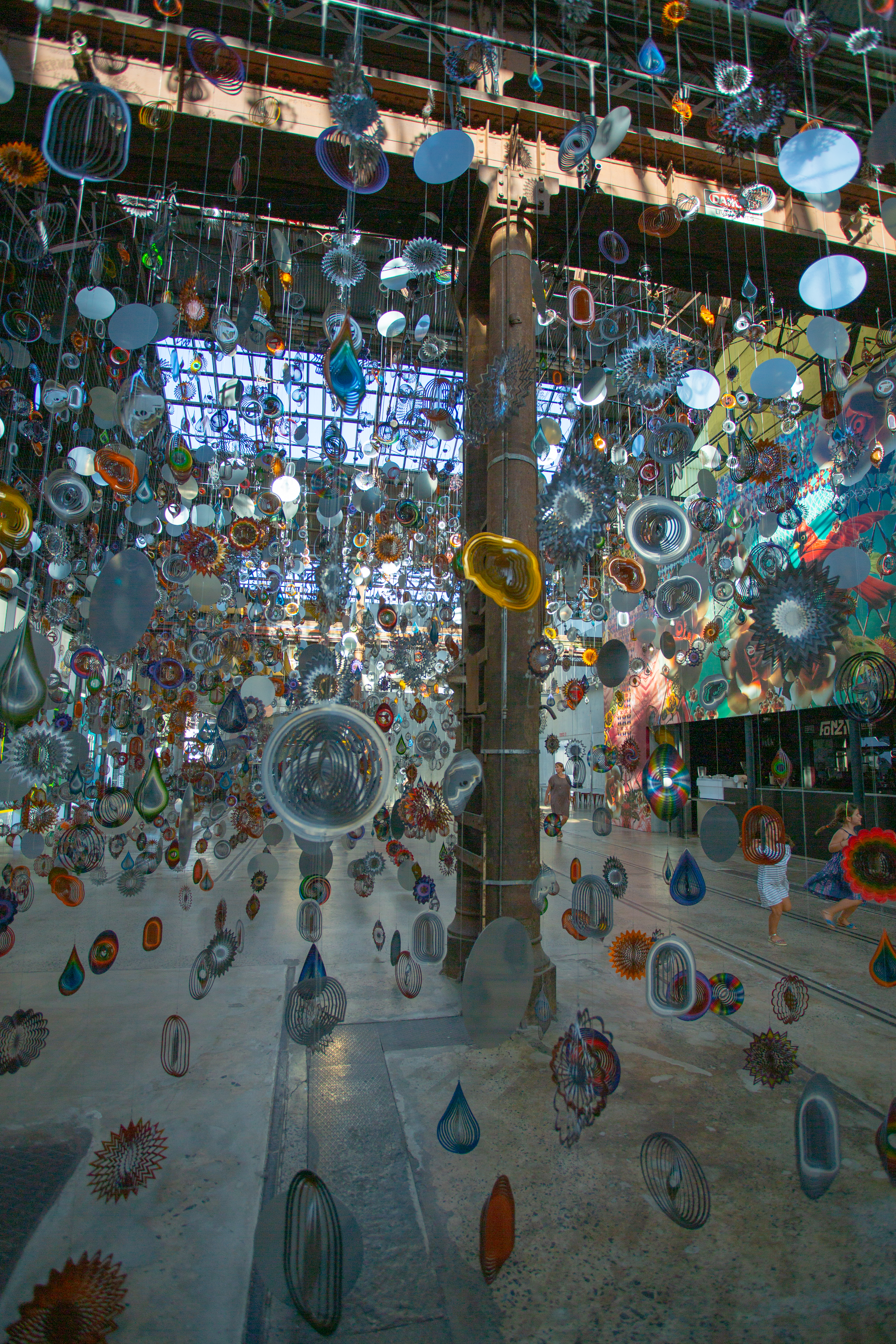
I caught a glimpse of the first installation, the Kinetic Spinner Forest, from outside the building: hundreds of shiny, metal spinners hanging on wires from the ceiling. I started walked around and snapping photos with a wide-angle lens, trying to capture the sheer scale of the piece, when I zeroed in on one spinner and then suddenly realized what I was looking at: guns.
Normally I do my homework when visiting a gallery, and if I had read the gallery guide ahead of time, I would have expected the guns. But this is one time in which I’m really glad I didn’t–because it hit me like a truck. The exhibit is beautiful, especially in the late-day summer sun, all color and shimmer. The guns are hidden in plain sight.
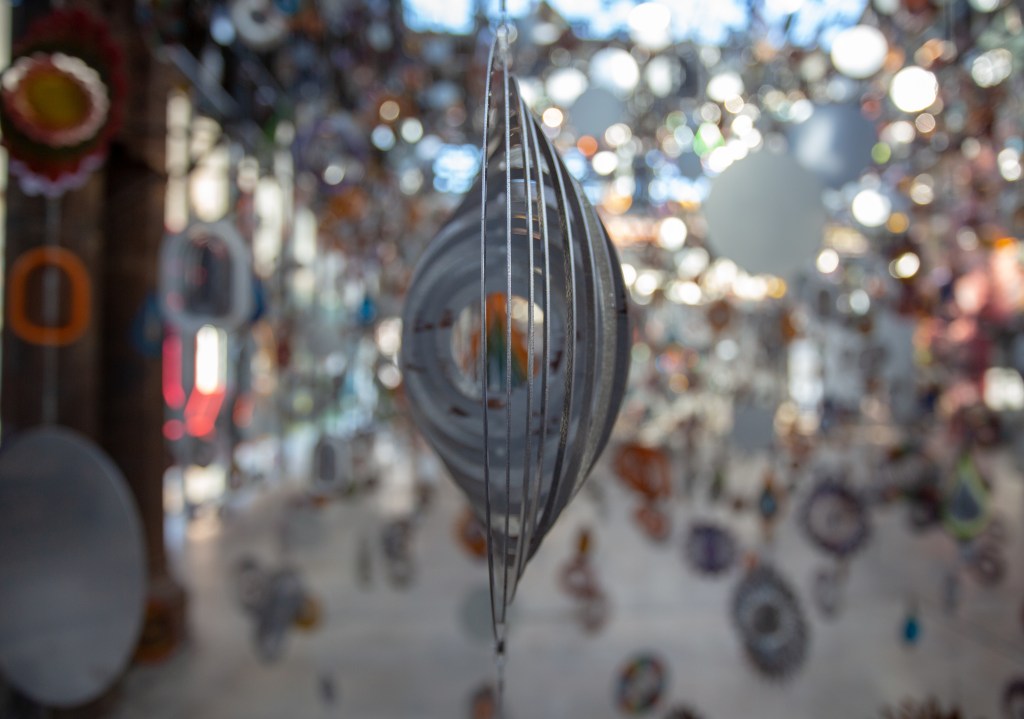
Kinetic Spinner Forest 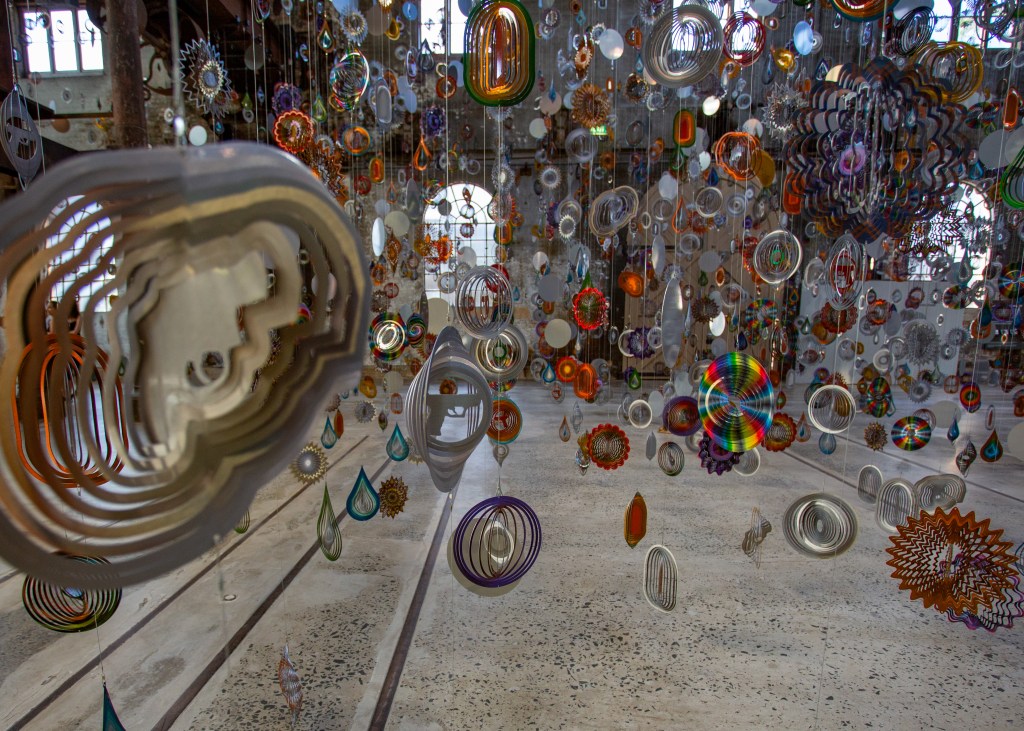
And there are the guns.
Next was the Crystal Cloudscape, a hanging island of sorts that has crystal chandeliers covering the bottom and a strange array of tchotchkes, lawn ornaments, and other random household items on top–the kind of things you’d expect to find in the drawing room of your eccentric eighty-year-old aunt. I climbed up each of the ladders, and the view was overwhelming with so many different items to examine; it wasn’t until the second ladder that I took note of the disturbing “racist memorabilia” in the mix.
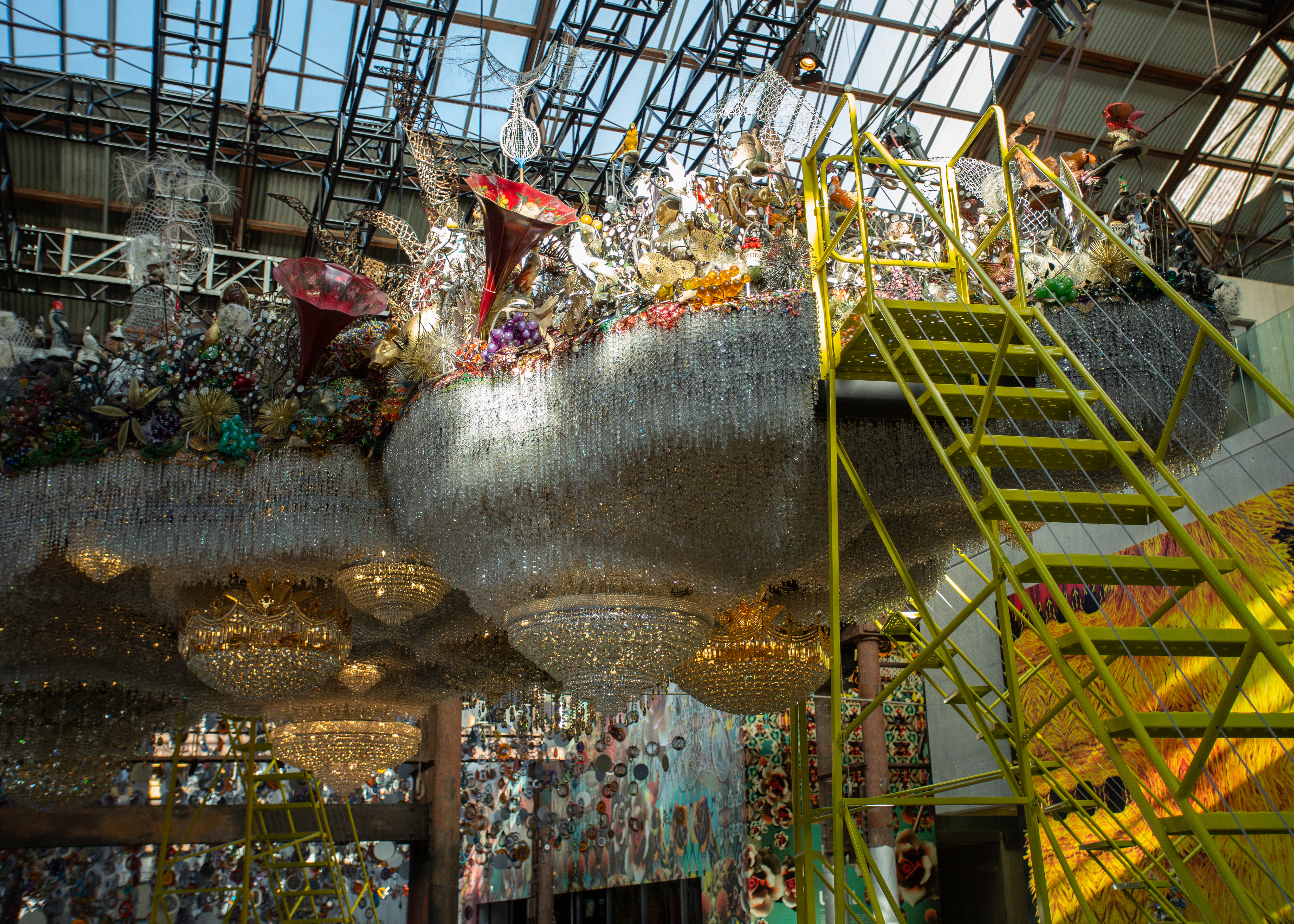
Statues that the gallery guide calls “lawn jockeys,” which reminded me of the exaggerated racist depictions of African-Americans in old picture books, seem to be playing on this island, chasing birds and butterflies with nets. The piece brought me back to the question in the exhibit introduction, of whether there is racism in heaven. Is this meant to be heaven? Are these racist caricatures of people free from racism here? Or is this some twisted version of heaven in which black people are still represented by such distorted figures? I’m not sure what Cave intended, or if he intended us to come away with an answer at all.
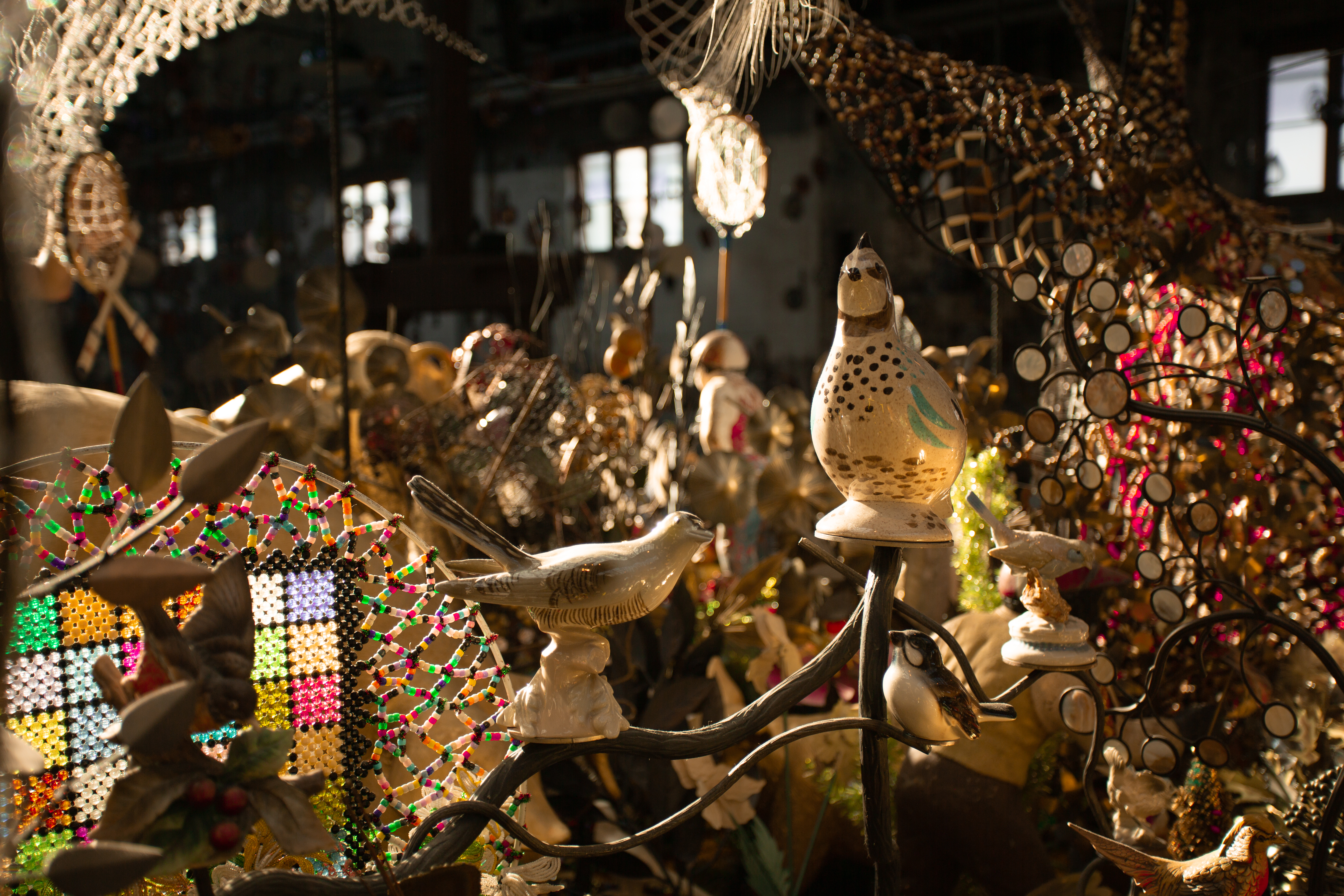
Random objects found atop Crystal Cloudscape 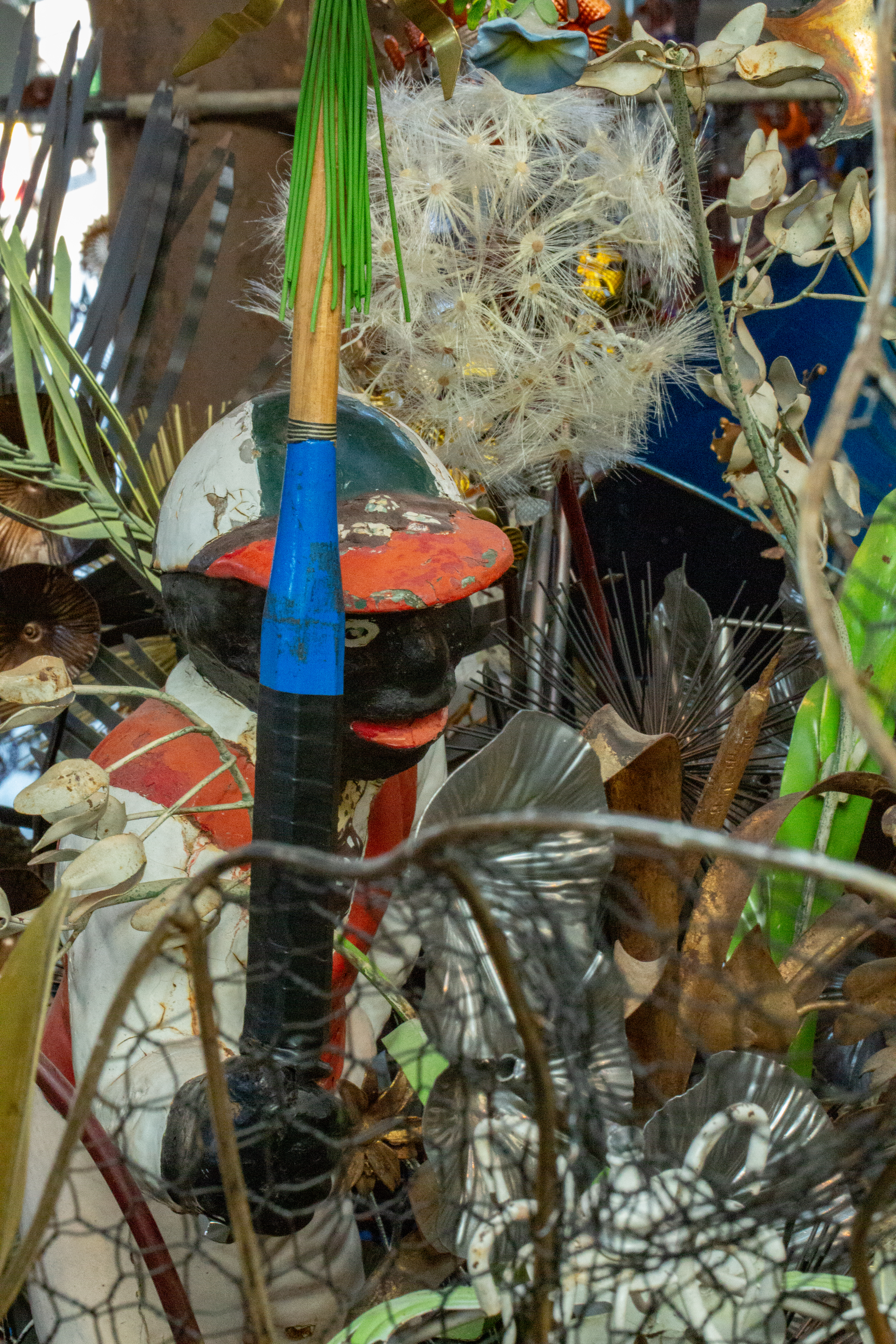
One of the lawn jockeys 
Another lawn jockey in the Crystal Cloudscape 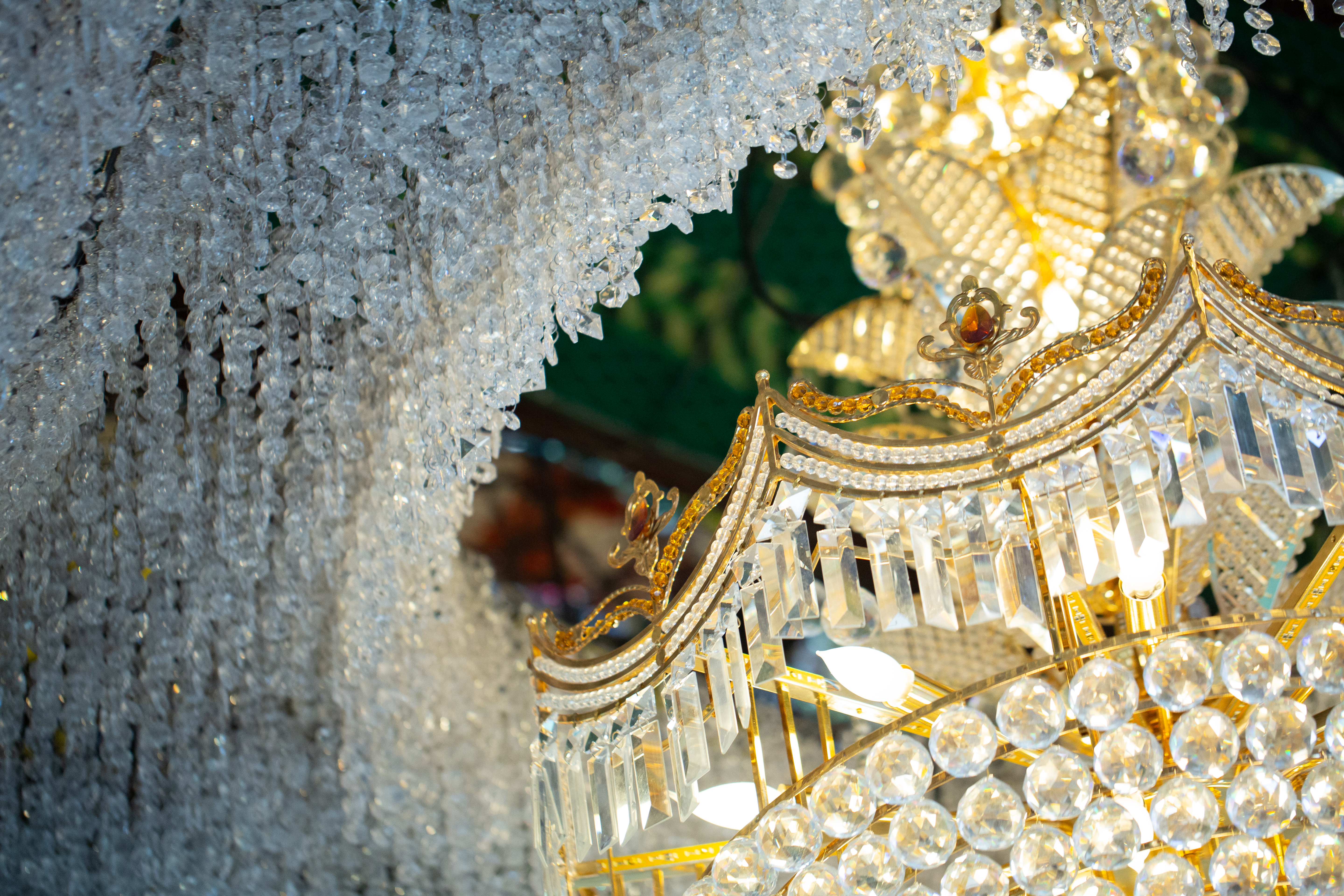
Close-up of a chandelier hanging from Crystal Cloudscape
I then walked into a large room at the end of the gallery and found myself in front of Flow / Blow, a wall of metallic streamers with fans behind it, which I must say was a glorious reprieve. I was melting inside Carriagehouse; it was in the high 20s outside and I am not used to temperatures like this. Flow / Blow was designed to provide “a sense of spacious relief,” according to the guide, which it certainly did for me, both physically and mentally.
In the same room is the Beaded Cliff Wall, which at first glance, as I was being cooled off in front of Flow / Blow, seemed to consist of heavy woven nets. When I ventured closer, I realized that the weavings are made from beads, the kind a child might make into a bracelet or which might be woven into hair. The piece has a symbolism that feels more playful, such as the colorful peace sign, rainbow, and smiley face; it also has a section of red, black, and green beads, the colors of black nationalism, embedded with the word POWER.

Between the curtains of the Beaded Cliff Wall 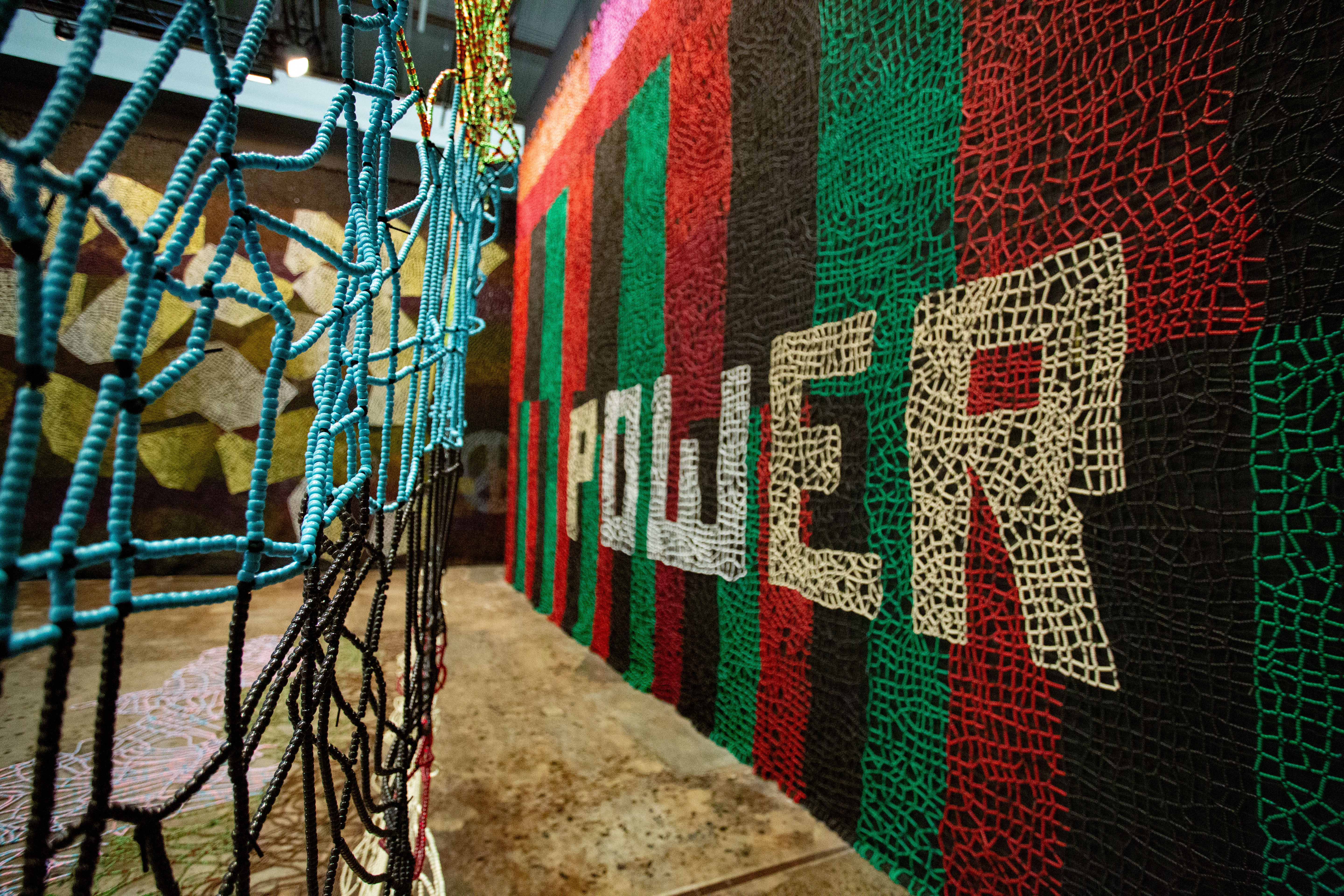
Another view from between the curtains
As I walked back into the main gallery space, I realized there was still one part of the exhibit that I hadn’t seen yet, an installation called Hy-Dyve. The piece is an audio-visual immersion in a smaller room, with videos of eyes covering every wall, looking back at the audience. I have to admit, I couldn’t stay in there for more than a couple of minutes. I don’t think I saw the entire video loop. It was just so incredibly agitating to be surrounded by those eyes. And I’m sure that’s the point: being watched, scrutinized, visually dissected, is disturbing. As Michael pointed out when I told him about my discomfort, Hy-Dyve clearly accomplished its purpose.
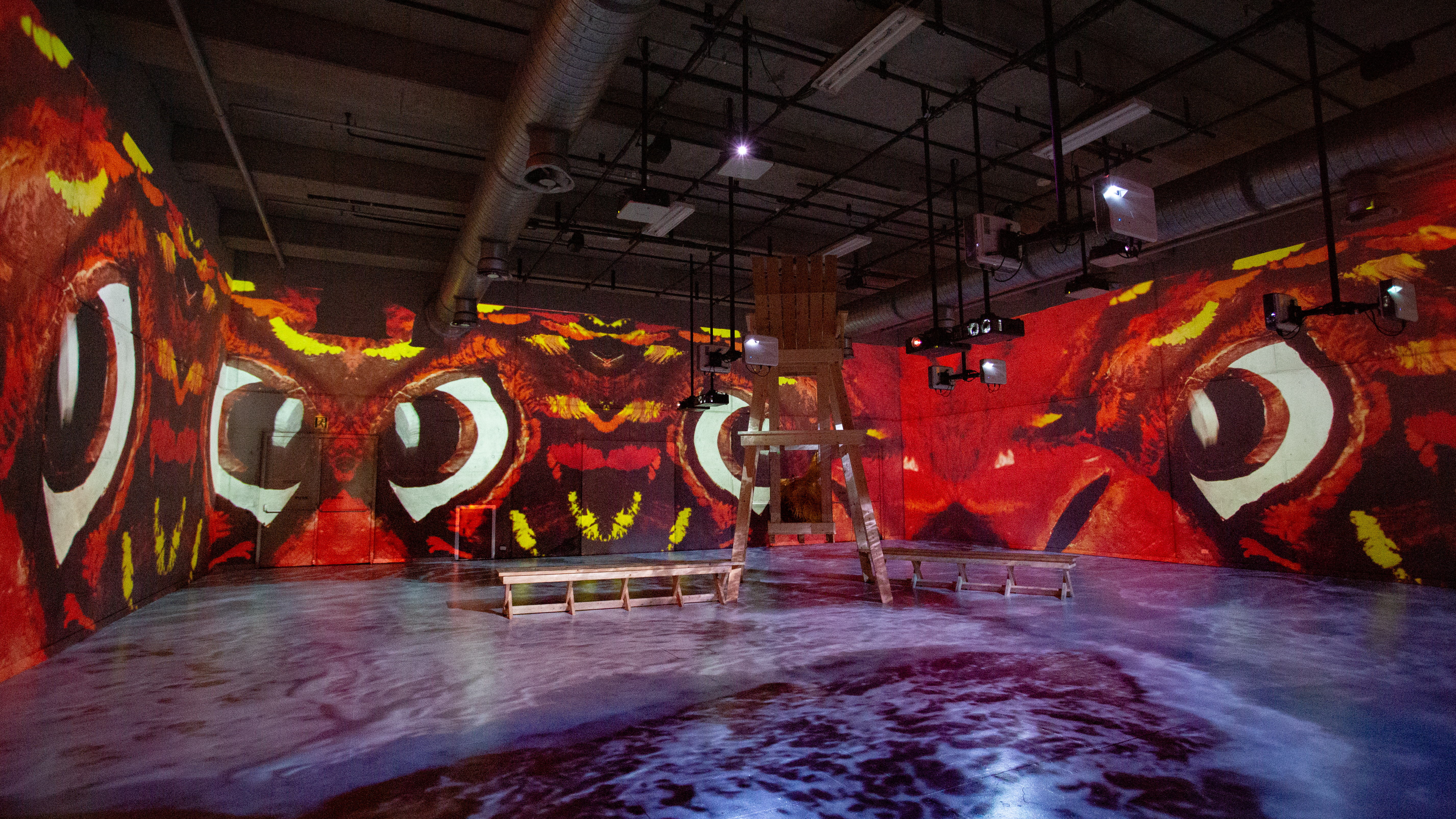
The Nick Cave exhibit is quite provocative. As an American, the imagery exploring racism and violence resonated with me on a significant level. It also made me wonder how the piece is being interpreted by the Australian audience. Gun violence, in particular, has come up in many of my conversations with people here, and it seems that many Aussies simply write off the US as “crazy” when it comes to our gun-control policies (or lack thereof). After the Parkland shooting almost one year ago, I had horrific nightmares about something similar happening in the school where I worked. I wonder what it is like to engage with a piece of artwork such as Kinetic Spinner Forest while knowing that mass shootings in public places are not something you need to fear. Is the piece more startling, or does it feel more remote?
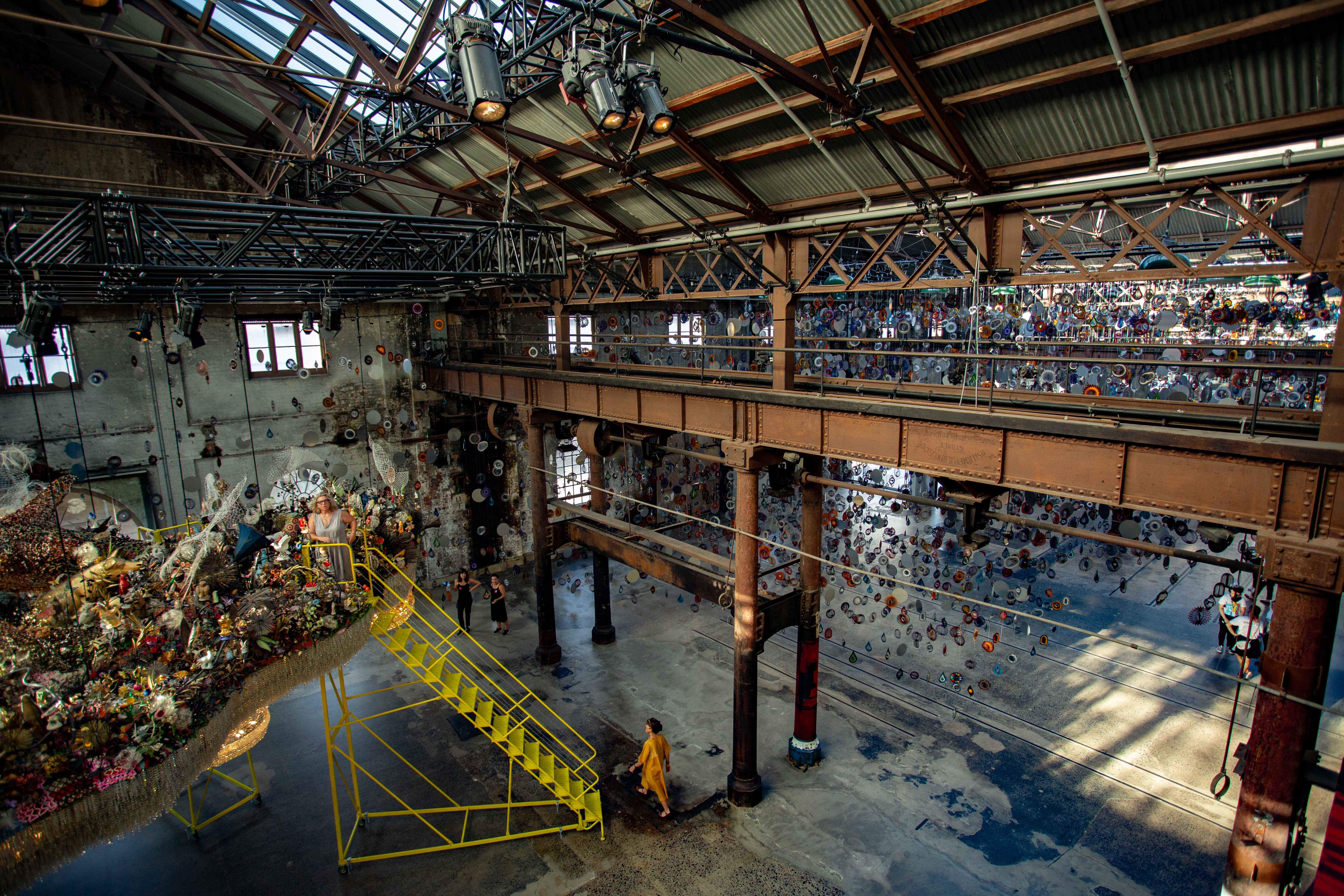
At this point, it was just about time for me to get into the theater queue for The Weekend. The play is a one-woman show, and according to this excellent SBS article, The Weekend is Henrietta Baird’s debut work. It also happens to be based on Baird’s real life experience.
The play follows Lara, a professional dancer, who is away working in Cairns when her younger son calls and tells her that their dad has disappeared and they are running out of food. Lara gets a flight back to Sydney, and after getting her kids settled in with groceries and some quality mom time, sets off to figure out where her partner, Simon, has disappeared to. She ends up in a dilapidated housing project with a drug dealer, Ronnie, who we learn has fallen on hard times and lost custody of her own children. The cast of supporting characters includes other drug addicts who each have their own painful stories: watching one parent stab another to death; losing a son to drugs and prison; being abandoned as a child.
The actress portraying all of these characters, Shakira Clanton, was incredible. Clanton gives each character a distinct voice and manner, and she tells their stories with heart-grabbing expression and emotion. And it isn’t all dark; there are funny moments in the story, too. In one scene, Lara is in a disgustingly dirty elevator, making wry observations and speculations about the filth, and Clanton’s gagging was so realistic that it made me gag in sympathy.
The Weekend spoke to me on multiple levels. On the one hand, it showed me something about poverty in Sydney; the colloquial language and references to nearby neighborhoods makes it very much of this time and place. But even more so, it was a confirmation that poverty, addiction, and abuse are the same everywhere. Listening to the struggles of each character reminded me of real stories I’ve heard from my students, about their own families and experiences. As gut-wrenching as it was to watch at times, The Weekend is also a reminder of our common humanity and strength to overcome.
For my first #top50inSydney event, Carriageworks did not disappoint. The space itself is architecturally interesting (though side note about the building: despite the List’s recommendation to check out the restrooms, I did not find anything there to be extraordinary nor unique). I found both the UNTIL exhibit and The Weekend to be moving, thought-provoking pieces of art, and I will definitely be keeping an eye out for what’s on at Carriageworks in the future.
 Kelly Wanders